Introduction
As Indian enterprises move workloads to the cloud, traditional network-perimeter-based security models break down entirely. Cloud environments have no meaningful perimeter — resources span multiple availability zones, regions, and often multiple cloud providers. Zero Trust cloud architecture provides the security model designed for this reality: trust nothing, verify everything, apply least privilege everywhere.
This guide explains how to build a Zero Trust cloud architecture step by step, covering the key pillars of identity, network, workload, and data security.
Why Zero Trust is the Right Model for Cloud
- Resources are accessed over the public internet — no network perimeter exists
- Identities (users, services, APIs) are the new perimeter — they must be verified continuously
- Lateral movement between cloud services is effortless without Zero Trust controls
- Cloud-native attacks target identity (IAM), misconfigured services, and APIs — not network perimeters
NIST SP 800-207 explicitly states that Zero Trust principles apply fully to cloud environments. The major cloud providers — AWS, Azure, and GCP — all have Zero Trust reference architectures that organisations can implement using native services.
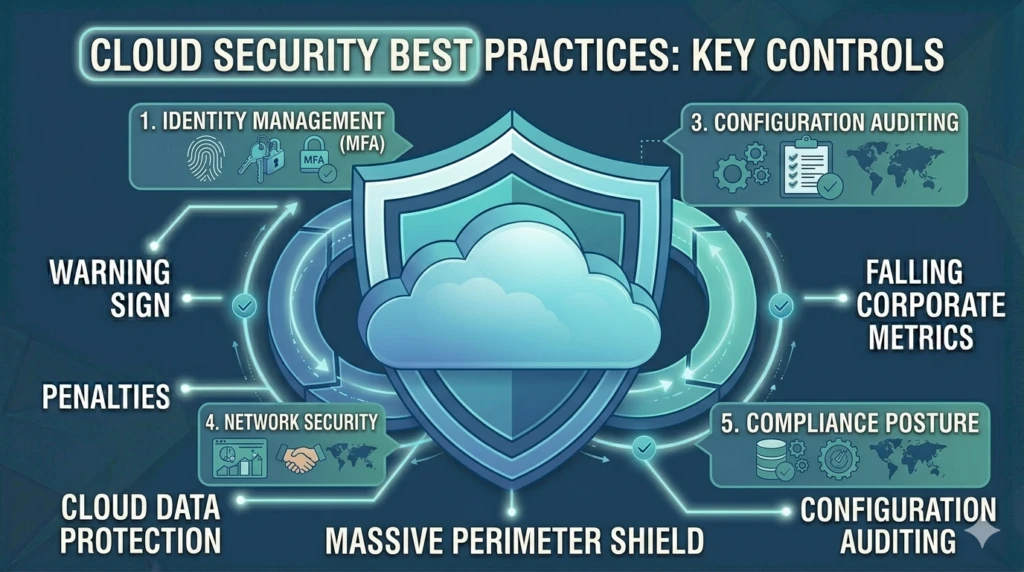
The Five Pillars of Zero Trust Cloud Architecture
| Pillar | Cloud Implementation | Key Services |
|---|---|---|
| Identity | Verify every access request based on strong identity | AWS IAM, Azure AD, Google Cloud Identity, PAM |
| Devices | Require device health attestation before granting access | MDM, Azure AD Conditional Access, AWS Device Trust |
| Network | Micro-segment cloud networks, use private endpoints | VPC, Security Groups, Private Link, ZTNA |
| Applications | Apply application-level access controls, not just network | API Gateway, WAF, CASB, App Proxy |
| Data | Classify, encrypt, and monitor data access continuously | KMS, DLP, CSPM, Macie/Purview/DLP API |
Building Zero Trust Cloud Architecture — Step by Step
Step 1: Implement Strong Cloud Identity
- Enable MFA for all human accounts — no exceptions for cloud console access
- Use IAM roles for application access — never embed long-lived access keys
- Implement Privileged Identity Management (PIM) — just-in-time privileged access for administrative tasks
- Deploy Single Sign-On (SSO) across all cloud services with a central identity provider
- Implement Conditional Access policies — grant access based on user, device, location, and risk signals
Step 2: Micro-Segment Cloud Networks
- Use separate VPCs/Virtual Networks for each environment and application
- Apply security groups/NSGs with deny-by-default rules — allow only explicitly required traffic
- Use private endpoints for cloud services — prevent data traversing the public internet
- Implement service mesh with mutual TLS for microservice-to-microservice communication
- Deploy Cloud Firewall / Network Firewall for centrally managed traffic inspection
Step 3: Deploy Cloud Security Posture Management
- AWS: AWS Security Hub + AWS Config
- Azure: Microsoft Defender for Cloud
- GCP: GCP Security Command Center
- Multi-cloud: Prisma Cloud, Wiz, or Orca Security
Configure CSPM to alert on any deviation from Zero Trust principles — for example, any storage bucket that becomes publicly accessible, any security group that opens port 22 or 3389 to the internet, or any IAM policy that grants wildcard permissions.
Step 4: Implement Zero Trust Network Access (ZTNA) for Remote Access
Replace traditional VPN with Zero Trust Network Access — granting employees access only to specific cloud resources they are authorised to use, rather than full network access. ZTNA continuously verifies identity and device health throughout the session, not just at connection time.
Step 5: Protect Cloud Workloads
- Deploy Cloud Workload Protection Platform (CWPP) for servers and containers
- Enable container image scanning and sign all container images
- Implement runtime security for containers — detect and block anomalous container behaviour
- Apply Web Application Firewall (WAF) rules to all public-facing applications
- Scan infrastructure as code (Terraform, CloudFormation) for misconfigurations before deployment
Step 6: Classify and Protect Cloud Data
- Classify all data stored in cloud services by sensitivity level
- Enable encryption at rest with customer-managed keys for sensitive data
- Implement DLP to detect and alert on sensitive data in unexpected locations
- Apply data access controls — limit access to sensitive data to specific roles and services
- Enable data residency controls to ensure personal data stays in India-region datacenters (DPDP Act compliance)
Step 7: Implement Continuous Monitoring and Detection
- Enable comprehensive logging — CloudTrail, Activity Logs, Audit Logs — for all API activity
- Deploy cloud-native threat detection — AWS GuardDuty, Microsoft Defender for Cloud, GCP Security Command Center
- Integrate cloud logs with SIEM for correlation and alerting
- Build cloud-specific detection rules for identity-based attacks, API abuse, and lateral movement
Zero Trust Cloud Maturity Model
| Maturity Level | Description | Key Characteristics |
|---|---|---|
| Level 1 — Traditional | Perimeter-based, minimal Zero Trust | Flat network, over-privileged IAM, no MFA |
| Level 2 — Initial | Basic Zero Trust elements in place | MFA deployed, some segmentation, logging enabled |
| Level 3 — Advanced | Zero Trust architecture in place | ZTNA, CSPM, micro-segmentation, DLP, CWPP |
| Level 4 — Optimal | Full Zero Trust — automated and continuous | Continuous verification, automated response, full visibility |
How Vedtam Can Help
Vedtam's cloud security team designs and implements Zero Trust cloud architectures for Indian enterprises across AWS, Azure, and GCP. From maturity assessments to full Zero Trust implementation programmes, we bring the architecture expertise and cloud security experience to transform your cloud security posture.
Visit vedtam.com/solutions/cloud-services/ and vedtam.com/solutions/network-security-solutions/ for more information.
Build your Zero Trust cloud architecture.
Free consultation: vedtam.com/contact/ | +91 98915 55588
Published by Vedtam Cybersecurity Team | Vedtam Tech Solutions, Ghaziabad, India