Introduction
ISO/IEC 27001 is the international standard for Information Security Management Systems (ISMS). For Indian enterprises seeking to demonstrate robust cybersecurity practices, win enterprise contracts, or comply with regulatory requirements, ISO 27001 certification is the gold standard credential. This step-by-step guide walks you through the complete certification journey.
What is ISO 27001?
ISO 27001 is published by the International Organization for Standardization (ISO) and the International Electrotechnical Commission (IEC). It specifies the requirements for establishing, implementing, maintaining, and continually improving an ISMS — a systematic framework for managing information security risks.
Certification is granted by accredited third-party certification bodies after an audit confirms that an organisation's ISMS meets the requirements of the standard. Certificates are valid for three years, with annual surveillance audits.
Why ISO 27001 Matters for Indian Companies
- Mandatory or preferred by enterprise and government clients in India and globally
- Required for many banking, healthcare, and government procurement tenders
- Demonstrates compliance with DPDP Act security obligations
- Provides a competitive advantage over uncertified competitors
- Reduces cyber insurance premiums by demonstrating mature security controls
- Builds customer and partner confidence in your security posture
ISO 27001 Structure — What You Need to Know
- Clauses 4–10 — Mandatory requirements covering context, leadership, planning, support, operations, performance evaluation, and improvement
- Annex A — 93 controls across 4 themes: Organisational, People, Physical, and Technological
Every organisation seeking certification must comply with all mandatory clauses. Annex A controls are selected based on a risk assessment — not all 93 controls apply to every organisation, but you must document why any control is excluded in a Statement of Applicability (SoA).
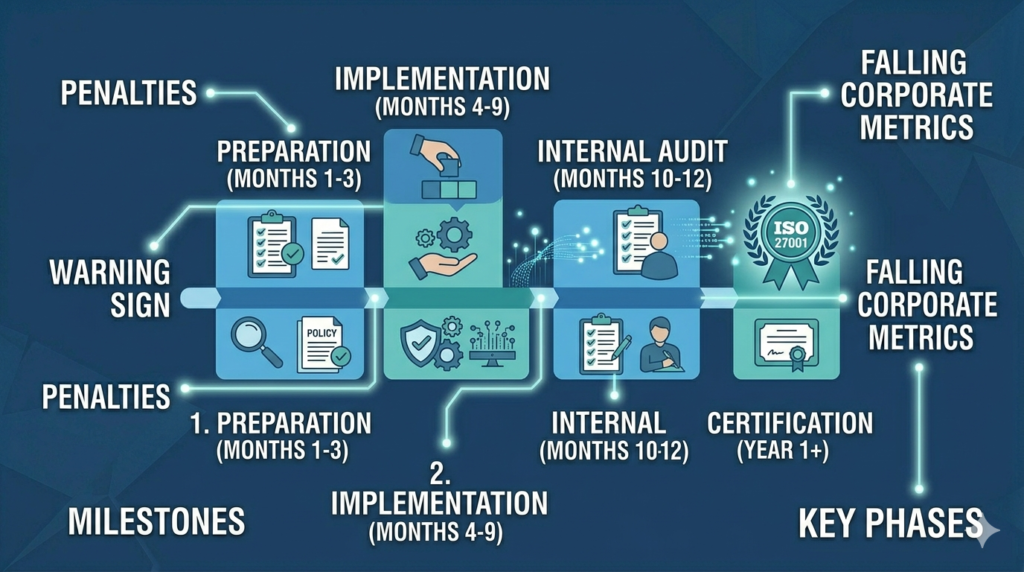
Step-by-Step ISO 27001 Certification Roadmap
Step 1 — Obtain Management Commitment (Week 1)
ISO 27001 requires top management commitment. This is not optional — the standard explicitly requires leadership to demonstrate commitment to the ISMS. Secure budget, appoint an ISMS project lead, and define the scope of certification.
Step 2 — Define ISMS Scope (Weeks 1–2)
Determine which parts of your organisation, systems, and processes are in scope for certification. A well-defined scope balances certification value against implementation effort. Common scopes include: entire organisation, a specific business unit, a particular service line, or a data centre.
Step 3 — Conduct Gap Assessment (Weeks 2–4)
Compare your current security practices against ISO 27001 requirements. Document gaps across all mandatory clauses and Annex A controls. This produces a prioritised remediation roadmap and a realistic estimate of certification effort and timeline.
Step 4 — Risk Assessment (Weeks 4–7)
Conduct a formal information security risk assessment. Identify assets, threats, vulnerabilities, and existing controls. Calculate risk levels (likelihood × impact). Document the risk treatment plan — specifying which risks will be mitigated, accepted, transferred, or avoided.
Step 5 — Select and Implement Controls (Weeks 6–16)
Based on your risk assessment, select appropriate controls from Annex A. Document your Statement of Applicability listing all 93 controls with implementation status and justification for any exclusions. Implement or strengthen controls as required.
Step 6 — Develop ISMS Documentation (Weeks 8–16)
ISO 27001 requires documented policies, procedures, and records. Key mandatory documents include: Information Security Policy, Risk Assessment Methodology, Statement of Applicability, Risk Treatment Plan, and evidence of control implementation.
Step 7 — ISMS Training and Awareness (Weeks 12–16)
Train all employees on the ISMS, their specific security responsibilities, and the policies that apply to their roles. Document training completion — auditors will ask for evidence.
Step 8 — Internal Audit (Weeks 16–18)
Conduct an internal audit of the ISMS against ISO 27001 requirements. Identify non-conformities and observations. Implement corrective actions before the external audit.
Step 9 — Management Review (Week 18)
Top management must formally review the ISMS performance, including internal audit results, risk treatment progress, and security incidents. Document the review minutes and decisions.
Step 10 — Stage 1 External Audit (Weeks 18–20)
The certification body conducts a document review (Stage 1 audit). They review your ISMS documentation against the standard and identify any areas requiring attention before the Stage 2 audit.
Step 11 — Stage 2 External Audit (Weeks 20–24)
The certification body conducts an on-site (or remote) audit to verify that your ISMS is implemented effectively. Auditors interview staff, review evidence, and test controls. Any non-conformities must be resolved before certification is granted.
Step 12 — Certification Awarded
Upon successful completion of Stage 2 with no outstanding major non-conformities, your ISO 27001 certificate is issued. Certificates are valid for 3 years with annual surveillance audits.
How Long Does ISO 27001 Certification Take?
| Organisation Size | Estimated Timeline | Key Variable |
|---|---|---|
| Small (up to 50 staff) | 3–6 months | Scope complexity |
| Medium (50–500 staff) | 6–12 months | Number of systems in scope |
| Large (500+ staff) | 12–18 months | Multi-site, complex infrastructure |
How Vedtam Can Help
Vedtam's ISO 27001 Consulting Services guide organisations through the complete certification journey — from initial gap assessment to post-certification surveillance support. Our consultants have hands-on experience across multiple industries and certification bodies, and we understand how to build lean, practical ISMS frameworks that pass audits without unnecessary bureaucracy.
Visit vedtam.com/consulting/iso-consulting-services/ to learn more.
Start your ISO 27001 journey today.
Free consultation: vedtam.com/contact/ | +91 98915 55588
Published by Vedtam Cybersecurity Team | Vedtam Tech Solutions, Ghaziabad, India