India is now the third most targeted country globally for cyberattacks, according to CERT-In's annual threat landscape reports. As Indian enterprises accelerate digital transformation, expand cloud adoption, and process growing volumes of sensitive data, the attack surface is expanding rapidly. Understanding the specific threats targeting Indian organisations — and how to defend against them — is essential for every CIO and CISO.
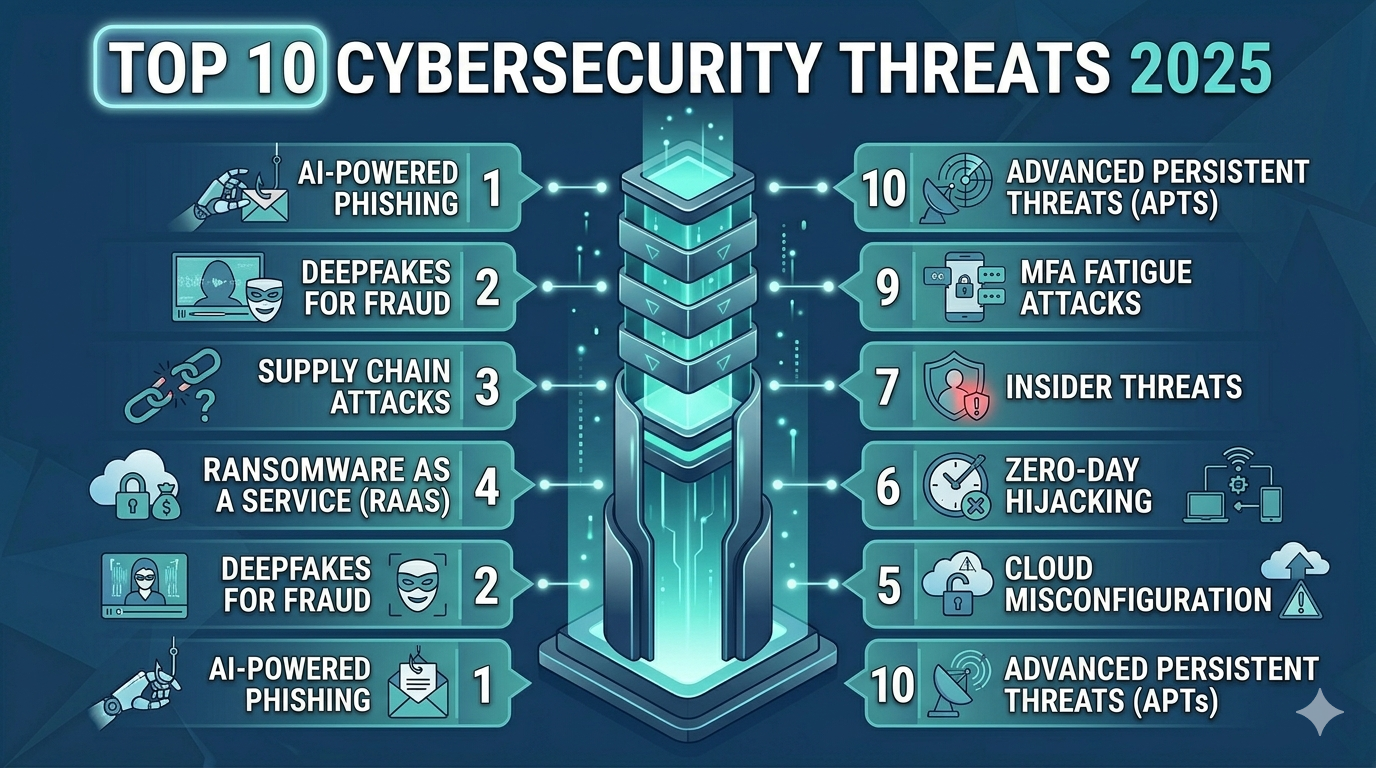
This article analyses the top 10 cybersecurity threats facing Indian enterprises in 2025, based on CERT-In threat data, global threat intelligence, and Vedtam's observations from client security assessments.
1. Ransomware Attacks Targeting Critical Infrastructure
Ransomware remains the most financially devastating cyber threat for Indian enterprises. Attackers have evolved from opportunistic spray-and-pray campaigns to targeted, high-value attacks against specific industries. Indian manufacturing, healthcare, and financial services organisations have been hit with ransom demands ranging from ₹50 lakh to ₹5 crore.
Modern ransomware operations — including groups like LockBit, BlackCat, and Play — now combine data encryption with data exfiltration (double extortion). They threaten to publish sensitive data on dark web leak sites unless the ransom is paid.
Key Mitigation: Offline, immutable backups tested regularly; network segmentation to limit lateral movement; EDR solutions with ransomware behavioural detection; multi-factor authentication to prevent initial access through credential theft.
2. Business Email Compromise (BEC)
BEC attacks are the second most financially damaging cyber threat globally — and India is a primary target. Attackers compromise or impersonate executive email accounts to authorise fraudulent wire transfers, redirect vendor payments, or manipulate employees into transferring sensitive data.
Indian enterprises have collectively lost thousands of crores to BEC fraud. The attacks are sophisticated — attackers monitor email communications for weeks before striking, ensuring their requests appear completely legitimate.
Key Mitigation: Email authentication (DMARC, DKIM, SPF); out-of-band verification for all financial instructions over a threshold; security awareness training focused on BEC recognition; privileged access management for finance teams.
3. Supply Chain Attacks
Supply chain attacks — where attackers compromise a trusted software vendor or service provider to reach their true targets — have become one of the most dangerous attack vectors. The SolarWinds, MOVEit, and 3CX attacks demonstrated how a single compromised vendor can expose thousands of downstream organisations simultaneously.
Indian enterprises that rely on third-party software platforms, managed service providers, or SaaS applications are exposed to supply chain risk even when their own security controls are strong.
Key Mitigation: Third-party risk assessments and security questionnaires; software bill of materials (SBOM) for critical applications; privileged access restrictions for vendor connections; network segmentation for third-party access.
4. Phishing and Spear Phishing
Phishing remains the most common initial access vector for cyberattacks globally — and phishing campaigns targeting Indian users have become significantly more sophisticated with the adoption of AI-generated content. Spear phishing attacks use personalised information gathered from LinkedIn, company websites, and social media to craft highly convincing targeted messages.
Phishing-as-a-Service platforms have democratised advanced phishing — attackers no longer need technical expertise to launch convincing campaigns that bypass traditional email security.
Key Mitigation: Advanced email security with AI-based phishing detection; phishing simulation and training; phishing-resistant MFA (FIDO2); clear reporting culture for suspicious emails.
5. Cloud Misconfiguration
As Indian enterprises rapidly migrate workloads to AWS, Azure, and GCP, cloud misconfiguration has emerged as a leading cause of data breaches. Common misconfigurations include publicly accessible S3 buckets, overly permissive IAM policies, unencrypted databases, and exposed management interfaces.
Cloud misconfigurations are particularly dangerous because they are often present for months or years before discovery — the Verizon Data Breach Investigations Report consistently identifies misconfiguration as one of the top breach causes.
Key Mitigation: Cloud Security Posture Management (CSPM) tools; automated misconfiguration scanning; principle of least privilege for all cloud IAM policies; encryption at rest for all sensitive data; cloud security training for DevOps teams.
6. Insider Threats
Insider threats — whether from malicious employees, contractors, or compromised insiders — are particularly difficult to detect and defend against because insiders already have legitimate access to systems and data. India's IT sector, with its high staff turnover and extensive use of contractors, faces elevated insider threat risk.
Key Mitigation: User and Entity Behaviour Analytics (UEBA); principle of least privilege; privileged access management; offboarding procedures that immediately revoke all access; data loss prevention (DLP) controls.
7. DDoS Attacks on Indian Financial and Government Services
Distributed Denial of Service (DDoS) attacks against Indian banks, payment processors, stock exchanges, and government digital services have increased significantly. Attacks are often ideologically motivated — linked to geopolitical tensions — or used as a distraction to cover other malicious activity.
Key Mitigation: DDoS protection services (Cloudflare, AWS Shield, Azure DDoS Protection); incident response playbooks for DDoS scenarios; redundant connectivity; business continuity plans that account for service unavailability.
8. API Security Vulnerabilities
As Indian enterprises build digital products and expose APIs to partners, customers, and internal applications, API security has become a critical concern. The OWASP API Security Top 10 lists broken object-level authorisation, authentication failures, and excessive data exposure as the most common API vulnerabilities — each capable of exposing sensitive data at scale.
Key Mitigation: API gateway with authentication and rate limiting; regular API security testing; runtime API monitoring; inventory of all published APIs; input validation and output encoding.
9. Mobile Device and Application Attacks
With Indian enterprises deploying mobile applications for customer-facing services, field operations, and employee access to corporate resources, mobile security has become a significant attack surface. Mobile malware targeting Indian banking customers, fake app store applications, and unsecured mobile device management are all active threat vectors.
Key Mitigation: Mobile Device Management (MDM) with encryption enforcement; mobile application security testing (MAST); certificate pinning for sensitive mobile apps; conditional access policies; employee BYOD security policies.
10. AI-Powered Attacks
2025 marks the year AI-powered attacks have moved from theoretical threat to operational reality. Attackers are using AI to generate hyper-personalised phishing content, create convincing deepfake audio and video for fraud, automate vulnerability discovery, and scale social engineering attacks. Indian enterprises must now defend against threats that operate at machine speed and human plausibility.
Key Mitigation: AI-powered defensive security tools (AI-based email security, EDR, SIEM); deepfake awareness training; out-of-band verification procedures; behavioural analytics to detect AI-assisted attack patterns.
Conclusion: Building a Threat-Informed Defence
The cybersecurity threat landscape facing Indian enterprises in 2025 is characterised by sophisticated, well-funded threat actors, rapidly evolving attack techniques, and an expanding attack surface driven by digital transformation. No single control will protect against all threats — effective enterprise defence requires a layered, threat-informed approach covering people, processes, and technology.
How Vedtam Can Help
Vedtam's cybersecurity services help Indian enterprises assess their exposure to these threats, implement effective countermeasures, and build the monitoring and response capabilities to detect and contain incidents before they become disasters.
Explore Cybersecurity Services →Assess your organisation's exposure to these threats. Free security consultation: vedtam.com/contact-us | +91 70651 11015