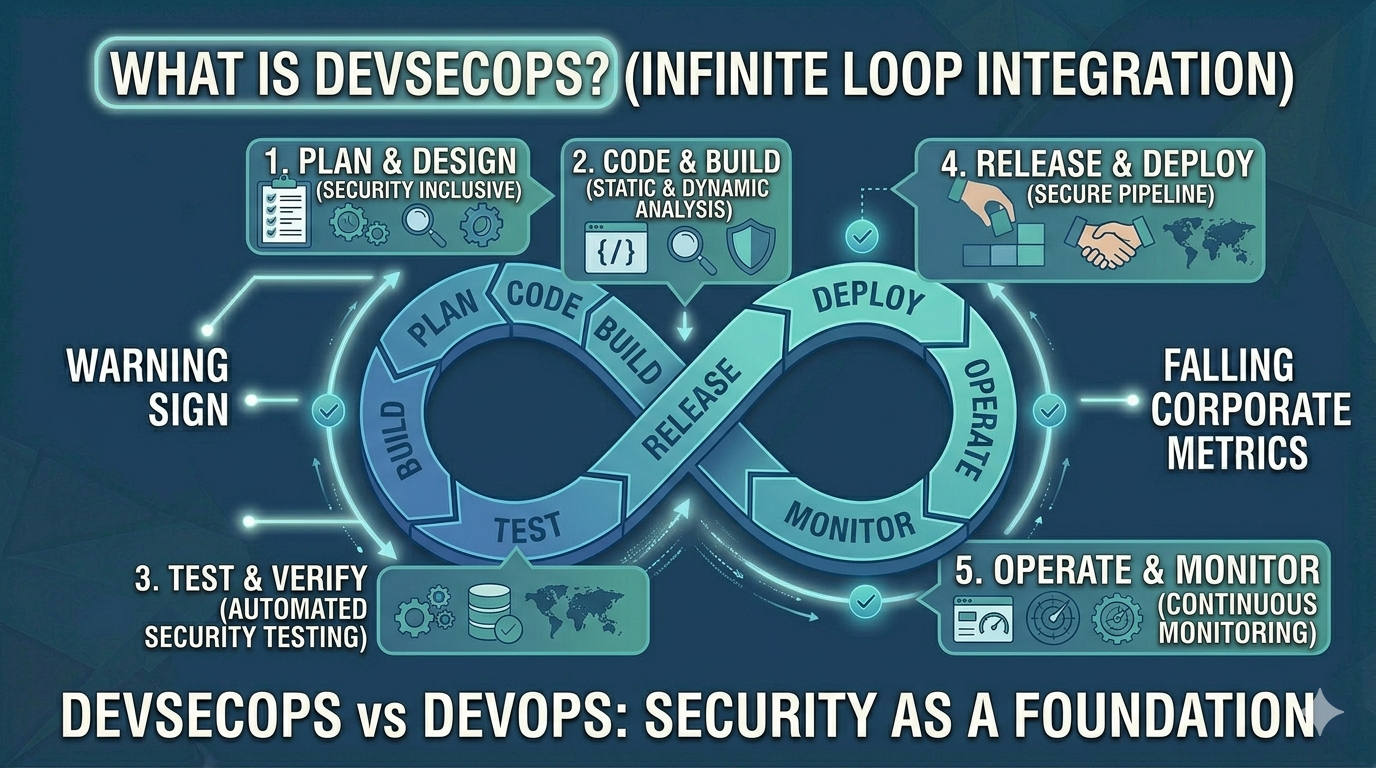
As Indian enterprises accelerate software delivery — building internal platforms, customer applications, and digital products — the traditional approach of adding security as an afterthought at the end of development is no longer viable. DevSecOps solves this by integrating security into every stage of the software development lifecycle, making security as automatic and continuous as testing and deployment.
What is DevOps?
DevOps is a set of practices, tools, and cultural philosophies that combines software development (Dev) and IT operations (Ops) to shorten the software development lifecycle and deliver high-quality software continuously. Core DevOps practices include Continuous Integration (CI), Continuous Delivery/Deployment (CD), infrastructure as code, automated testing, and monitoring.
What is DevSecOps?
DevSecOps extends DevOps by integrating security (Sec) into the CI/CD pipeline and development culture. Rather than treating security as a gate at the end of development — a phase that slows delivery and creates confrontation between security and development teams — DevSecOps makes security everyone's responsibility and automates security checks throughout the pipeline.
The goal is to shift security left — catching vulnerabilities earlier in the development process when they are cheaper and faster to fix.
| Aspect | DevOps | DevSecOps |
|---|---|---|
| Security Timing | End of pipeline (if at all) | Throughout the entire pipeline |
| Security Ownership | Security team (separate gate) | Shared — every developer, every stage |
| Security Testing | Manual, periodic penetration testing | Automated, continuous security scanning |
| Vulnerability Discovery | Late — often in production | Early — in developer's IDE or CI/CD |
| Speed Impact | Security slows final delivery | Security is built into speed — no extra gate |
| Culture | Dev vs Ops collaboration | Dev + Sec + Ops collaboration |
The DevSecOps Pipeline
Plan Phase
- Threat modelling during design — identify potential attack surfaces before code is written
- Security requirements definition — include security user stories alongside functional requirements
- Dependency risk assessment — review third-party libraries and frameworks for known vulnerabilities
Code Phase
- IDE security plugins — real-time security feedback as developers write code (e.g., SonarLint, Snyk)
- Pre-commit hooks — automatically scan code for secrets and credentials before they are committed to version control
- Peer code review with security lens — include security considerations in code review checklists
Build Phase
- Static Application Security Testing (SAST) — automated scanning of source code for security vulnerabilities
- Software Composition Analysis (SCA) — scan open-source dependencies for known CVEs
- Secrets scanning — detect API keys, passwords, and credentials accidentally committed to code
Test Phase
- Dynamic Application Security Testing (DAST) — test running application for vulnerabilities
- Interactive Application Security Testing (IAST) — security testing during automated functional tests
- Container image scanning — scan Docker images for vulnerabilities before deployment
Deploy Phase
- Infrastructure as Code (IaC) security scanning — scan Terraform, CloudFormation, and Ansible scripts for misconfigurations
- Policy-as-code enforcement — automatically reject deployments that violate security policies
- Runtime protection — deploy Runtime Application Self-Protection (RASP)
Operate and Monitor Phase
- Continuous monitoring for vulnerabilities in production
- Security event logging and SIEM integration
- Automated response to detected threats
Key DevSecOps Tools
| Category | Popular Tools |
|---|---|
| SAST | SonarQube, Checkmarx, Veracode, Semgrep |
| SCA / Dependency Scanning | Snyk, OWASP Dependency-Check, WhiteSource |
| DAST | OWASP ZAP, Burp Suite, Detectify |
| Container Security | Trivy, Twistlock, Aqua Security, Clair |
| IaC Security | Checkov, tfsec, Terrascan |
| Secrets Detection | GitGuardian, TruffleHog, detect-secrets |
| CI/CD Platforms | Jenkins, GitLab CI/CD, GitHub Actions, Azure DevOps |
Building a DevSecOps Culture
Technology is only part of DevSecOps — culture is equally important. Security teams must shift from being the department that says 'no' to being security champions who enable developers to build securely. Key cultural shifts include:
- Security champions — embed security-minded individuals within development teams
- Developer security training — teach developers how to write secure code, not just tell them to
- Blameless post-mortems for security incidents — focus on systemic improvements, not individual blame
- Security metrics in developer performance — track and reward security-conscious development practices
How Vedtam Can Help
Vedtam's DevOps and DevSecOps services help Indian enterprises integrate security into their development pipelines — from tool selection and pipeline design to security champion training and security policy implementation.
Explore DevSecOps Solutions →Integrate security into your development pipeline. Free consultation: vedtam.com/contact-us | +91 70651 11015