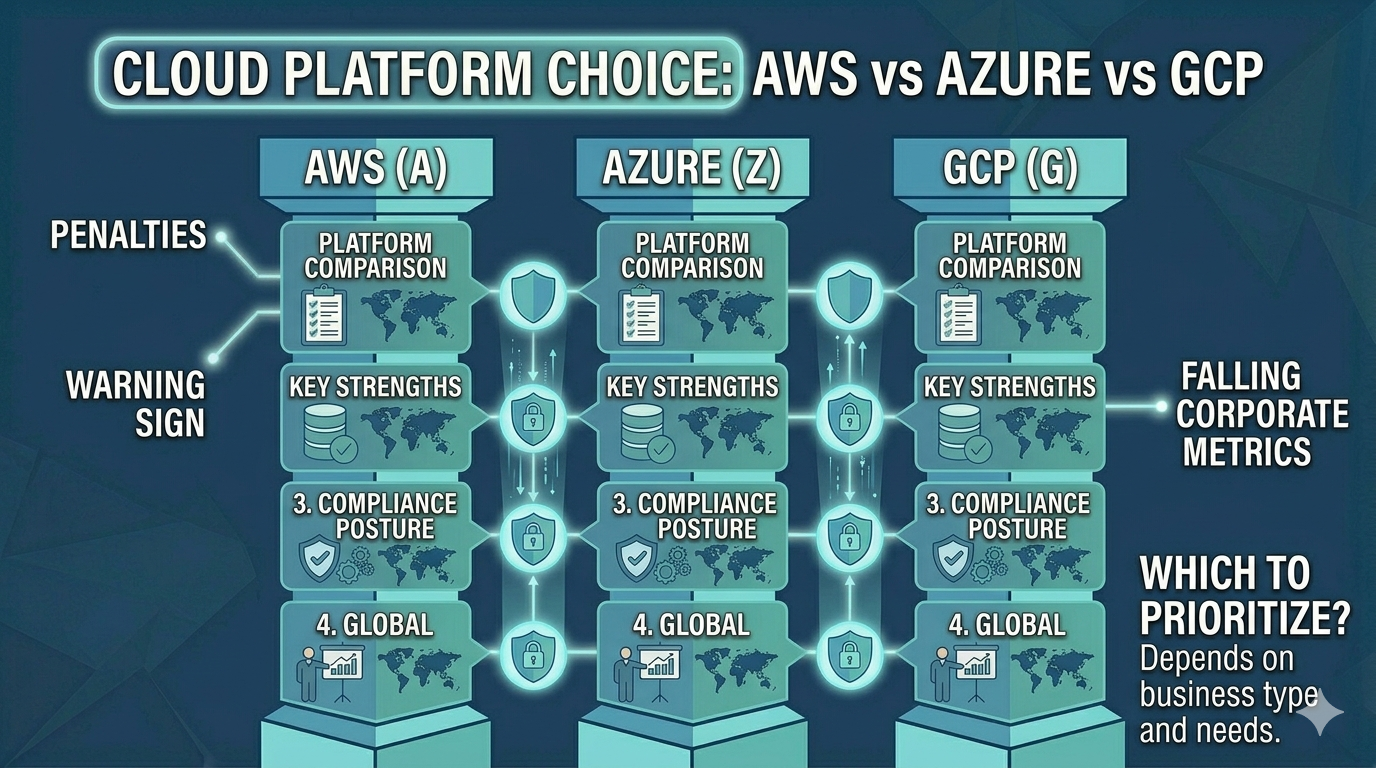
Choosing the right cloud platform is one of the most consequential technology decisions an enterprise can make. AWS, Microsoft Azure, and Google Cloud Platform (GCP) each have distinct strengths, pricing models, compliance certifications, and Indian datacenter presences. The right choice depends heavily on your existing technology stack, workload types, compliance requirements, and organisational capabilities.
This guide provides an objective comparison to help Indian enterprises make an informed cloud platform decision.
Market Overview — Where India Stands
India is one of the fastest-growing cloud markets globally, with AWS, Azure, and GCP all operating local datacenters within India (Mumbai, Pune, Delhi/NCR regions). Local datacenters matter for data residency requirements — increasingly important under India's DPDP Act and sector-specific regulations from RBI, IRDAI, and SEBI.
| Factor | AWS | Microsoft Azure | Google Cloud (GCP) |
|---|---|---|---|
| Market Position | #1 globally, very strong in India | #2 globally, strong in enterprise India | #3 globally, growing fast |
| India Datacenters | Mumbai (2 AZs), Hyderabad (2 AZs) | Pune, Chennai, Mumbai (planned) | Mumbai, Delhi |
| Service Breadth | Widest — 200+ services | Very broad — 200+ services | Narrower but strong in AI/ML, data |
| Enterprise Strength | Startup to enterprise — very versatile | Strongest for Microsoft-heavy enterprises | Strong for data and AI workloads |
| Pricing Model | Complex — many options | Complex — enterprise agreements common | Generally competitive, committed use discounts |
| Support Ecosystem | Largest partner ecosystem | Very large — especially Microsoft partners | Smaller but growing |
| Compliance Certifications | Most comprehensive — RBI, SEBI, ISO 27001, SOC 2 | Strong — especially for regulated industries | Growing — ISO 27001, SOC 2 |
When to Choose AWS
- You are building a cloud-native application from scratch — AWS has the most mature services and the deepest ecosystem
- You need the widest range of managed services — AWS leads in breadth across compute, storage, databases, AI/ML, and networking
- You are building a startup or digital product — AWS's free tier, startup programmes, and developer tooling are industry-leading
- Your team has the most cloud skills in AWS — talent availability matters in India, and AWS-certified professionals are most abundant
- You need the most geographic flexibility — AWS has the largest global footprint
When to Choose Microsoft Azure
- Your organisation is heavily invested in the Microsoft stack — Windows Server, Active Directory, Office 365, SQL Server, .NET — Azure integration is seamless and licensing savings can be significant
- You are migrating existing on-premises Microsoft infrastructure to the cloud — Azure Hybrid Benefit and Azure Arc make this the most efficient path
- You are in a regulated industry (banking, insurance, healthcare) — Azure has strong compliance certifications and regulatory framework documentation for Indian financial sector regulators
- You need Microsoft-specific services — Azure DevOps, Microsoft Sentinel SIEM, Azure Active Directory, Power Platform
- Your enterprise procurement prefers Microsoft relationships — many Indian enterprises have existing Microsoft enterprise agreements
When to Choose Google Cloud (GCP)
- You have large-scale data analytics and machine learning workloads — BigQuery, Vertex AI, and GCP's data services are best-in-class
- You are building AI-intensive applications — Google's AI/ML capabilities and Tensor Processing Units give GCP a genuine edge
- You use Google Workspace — the GCP/Workspace integration is excellent
- You need Kubernetes expertise — Google invented Kubernetes and GKE (Google Kubernetes Engine) remains the reference implementation
- Price optimisation is a priority — GCP's sustained use discounts and committed use contracts often deliver the best price-performance for compute
Multi-Cloud Strategy — When It Makes Sense
Many large Indian enterprises run multi-cloud environments. This can make sense when:
- Different workloads genuinely run better on different platforms (analytics on GCP, Microsoft workloads on Azure, everything else on AWS)
- Regulatory requirements mandate data residency in multiple regions with different provider coverage
- Vendor lock-in risk mitigation is a board-level priority
However, multi-cloud also increases complexity, management overhead, security surface area, and skills requirements. For most Indian SMEs and mid-market enterprises, a primary cloud provider with a secondary provider for specific workloads is more practical than full multi-cloud.
Compliance Considerations for Indian Enterprises
| Regulation | AWS | Azure | GCP |
|---|---|---|---|
| RBI Cloud Guidelines | Compliant — guidance documentation available | Compliant — detailed RBI framework alignment | Compliant — guidance available |
| SEBI Cloud Framework | Supported | Supported | Supported |
| CERT-In Requirements | Local DC available, compliance documentation | Local DC available, compliance documentation | Local DC available |
| DPDP Act Data Residency | India DC available | India DC available | India DC available |
| ISO 27001 | Certified | Certified | Certified |
| SOC 2 Type II | Available | Available | Available |
Decision Framework
| Your Situation | Recommended Platform |
|---|---|
| Microsoft-heavy enterprise | Azure primary |
| Cloud-native startup or SaaS | AWS primary |
| Data/AI intensive workloads | GCP primary or hybrid GCP+AWS |
| Regulated financial services | Azure or AWS — both have strong RBI/SEBI documentation |
| No strong preference, best ecosystem | AWS |
| Multi-cloud required | AWS + Azure, with GCP for data workloads |
How Vedtam Can Help
Vedtam's Cloud Services team helps Indian enterprises design, migrate, secure, and optimise cloud environments across AWS, Azure, and GCP. We provide vendor-neutral advisory — recommending the platform that genuinely best fits your needs, not the one with the best partner incentives.
Explore Cloud Services →Get a vendor-neutral cloud platform assessment. Free consultation: vedtam.com/contact-us | +91 70651 11015